

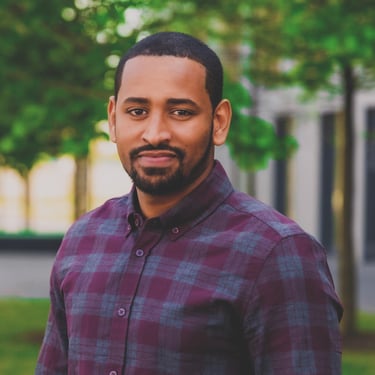
Dr. Bereket A. YILMA
Founder / Program Director
Dr. Bereket A. Yilma is a scientist, educator, entrepreneur, and visionary of Artistic Digital Mental Health Care, founder of ArtAICare, the first end-to-end digital art therapy platform and the ArtAICare Academy. His work blends human-centred artificial intelligence, cognitive neuroscience, and digital intervention design to advance personalized and adaptive digital systems across multiple domains, including mental health care, adaptive museum guidance, and collaborative robotics in industrial settings. He earned a PhD in Artificial Intelligence, a Master’s in Computer Science (AI), and a Bachelor’s in Computer & Information Sciences, with a strong focus on personalization, adaptive interfaces, and interactive intelligent environments.
Before founding ArtAICare, Dr. Yilma worked extensively at the forefront of research and development within major European research institutions and universities, including the Bruno Kessler Foundation (FBK), the University of Trento, the Research Center for Automatic Control (CRAN) jointly with the French National Scientific Research Center (CNRS), the Luxembourg Institute of Science and Technology (LIST), contributing to advanced projects exploring recommender systems, affective computing, multimodal interactions, and adaptive user modeling. He was also a Visiting Scholar in the United States at the University of Pittsburgh, School of Computing and Information. His scholarly works have been published and presented in top-tier international scientific venues in artificial intelligence and human–computer interaction.
Currently, Dr. Yilma serves as the CEO of ArtAICare and Program Director of the ArtAICare Academy. He is a firm believer that Mental health care professionals should be the leaders of the AI revolution in the therapeutic space. Hence, his effort at the academy is leading the design and deployment of AI-enabled digital art therapy systems and advanced training programs for mental health professionals focused on translating research into clinically grounded digital interventions, ensuring that AI systems support therapeutic decision-making and treatment design without replacing professional expertise. In parallel, he serves as a Lecturer at the University of Luxembourg and an active member of the Computational Interaction Research team, contributing to ongoing research in artificial intelligence and Human-Computer Interaction (HCI).
